
- Service in 4 Hours
- Free Inspection
[section class="intro_1" style="bg_color05" pad="pad2"]
Free [service] Inspection. Service in 4 Hours.
Call us today before noon and we can be at your home within 4 hours to provide a free, zero obligation inspection and estimate. Need [service case="lower"] control service? We can do that too, today!
Get COUPON OFF [service] Control Service With This Internet Only Offer
[company] is the #1 [location] pest control & extermination company. We have over [yearsInService] years experience, and have helped over [homeCount] homeowners and businesses with [service] extermination and other pest control. Read on to learn why we are the top choice for pest control in [location], then pick up the phone and call us for [metaTime] help with your pest problems.
[/section]Free Inspections & Estimates
[metaTime] Service, No Extra Charge
[yearsInService] Years Experience
Results 100% Guaranteed
Locally Owned & Operated
Fully Trained, Licensed, & Insured Technicians
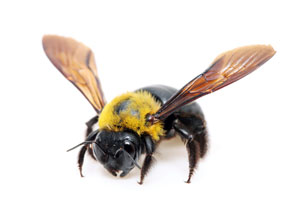
Appearance – There are two primary types of carpenter bees in North America, large and small. The larger bees are more often the ones causing damage for property owners and are slightly less than an inch in size. They are often confused with bumble bees due to their size and hairy upper bodies. The carpenter bee has a black, shiny lower body, unlike a bumble bee which has a hairy bottom.
Behavior- Carpenter bees hollow out wood to form their new homes, often in the wood siding of your home. It is not uncommon for carpenter bees to use pre-existing tunnels rather than create new ones. Often damage occurs above the first level of your residence in the form of perfectly shaped holes in the siding. Carpenter bees do not eat wood and will leave wood bits and dust behind as a sign of their current residence in your walls where they will seek shelter and have their young. Male carpenter bees will not sting but are known to aggressively “dive bomb” perceived threats to the nest.
Carpenter bees seek out dry wood to live in. The wood of house siding, door trim, and window sills are good homes, as well as many other worn or unpainted wooden surfaces. carpenter bees set their sights high, so if you live near or own a home that has multiple stories, carpenter bees will most likely burrow on the second floor – for their own safety.
Carpenter bee activity tends to be a nuisance and a threat to your residence. Too many carpenter bees burrowing at once can cause costly structural and aesthetic damage to the side of your home. Woodpeckers will often peck into house siding seeking carpenter bee larvae for food. While they do not sting, male carpenter bees are territorial. Female carpenter bees can sting if provoked which can be a danger to your family and pets.
Call us today for carpenter bee control, so you and your family can rest assured your home will be safe.
We had a wonderful experience with our technician. Weston was easy to talk to and explained everything well. Josh, who sold us the service, was very kind also. Not pushy at all. And very informative. Thank you. We look forward to working with you in the future.
We had a wonderful experience with our technician. Weston was easy to talk to and explained everything well. Josh, who sold us the service, was very kind also. Not pushy at all. And very informative. Thank you. We look forward to working with you in the future.
We had a wonderful experience with our technician. Weston was easy to talk to and explained everything well. Josh, who sold us the service, was very kind also. Not pushy at all. And very informative. Thank you. We look forward to working with you in the future.

[company] guarantees its treatment plan for a full year. If for whatever reason you have any new [service case="lower"] problems or other covered pests, we will treat immediately and at no cost to you. Immediately means you are our priority – not when we can fit you into our schedule.
The barriers we put in place to protect your home and family against pests will naturally break down over time. This is why over the course of the year we will regularly reapply treatments to ensure your home is protected. For more details on our treatment schedule read our Home Protection Plan page.
Your home is your largest investment.
Let [company] protect it against pests!